
Ceramic memorial photos for cemetery crosses and monuments

Oval ceramic photo for gravestone crosses
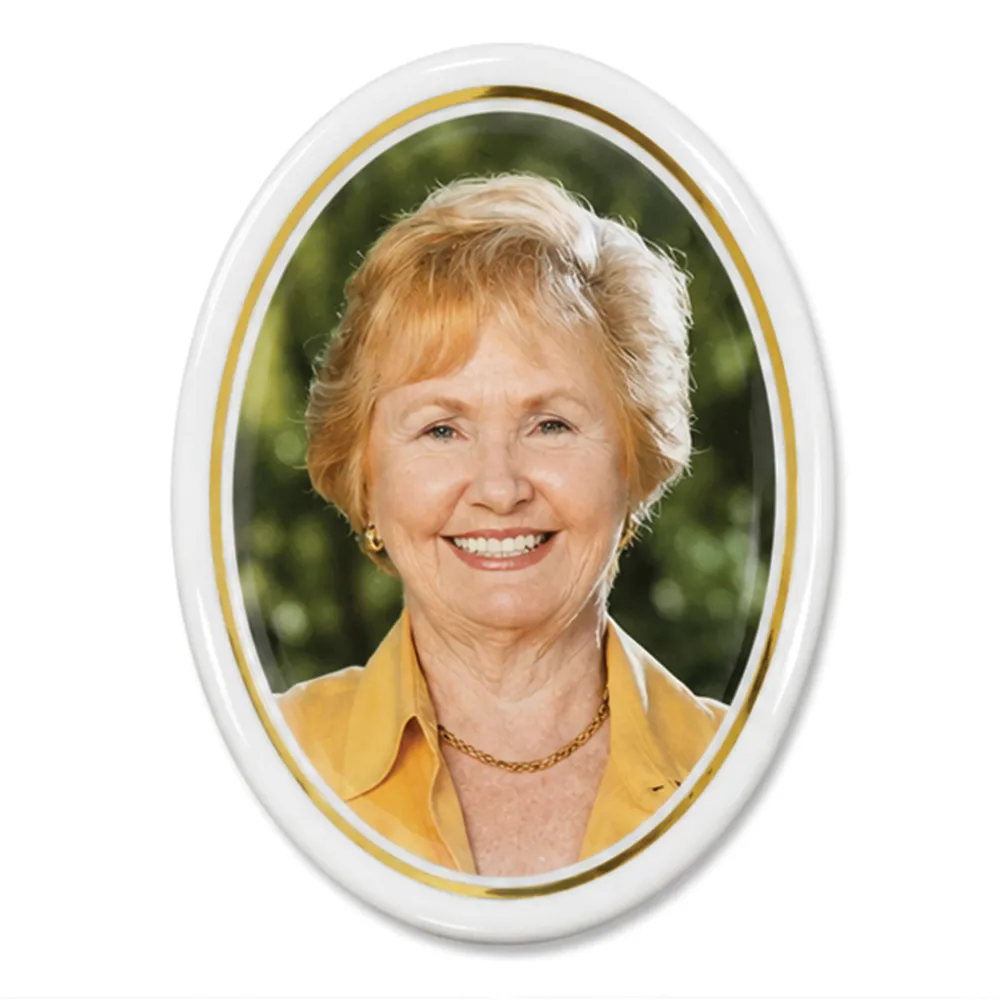
Oval ceramic photo with gold trim
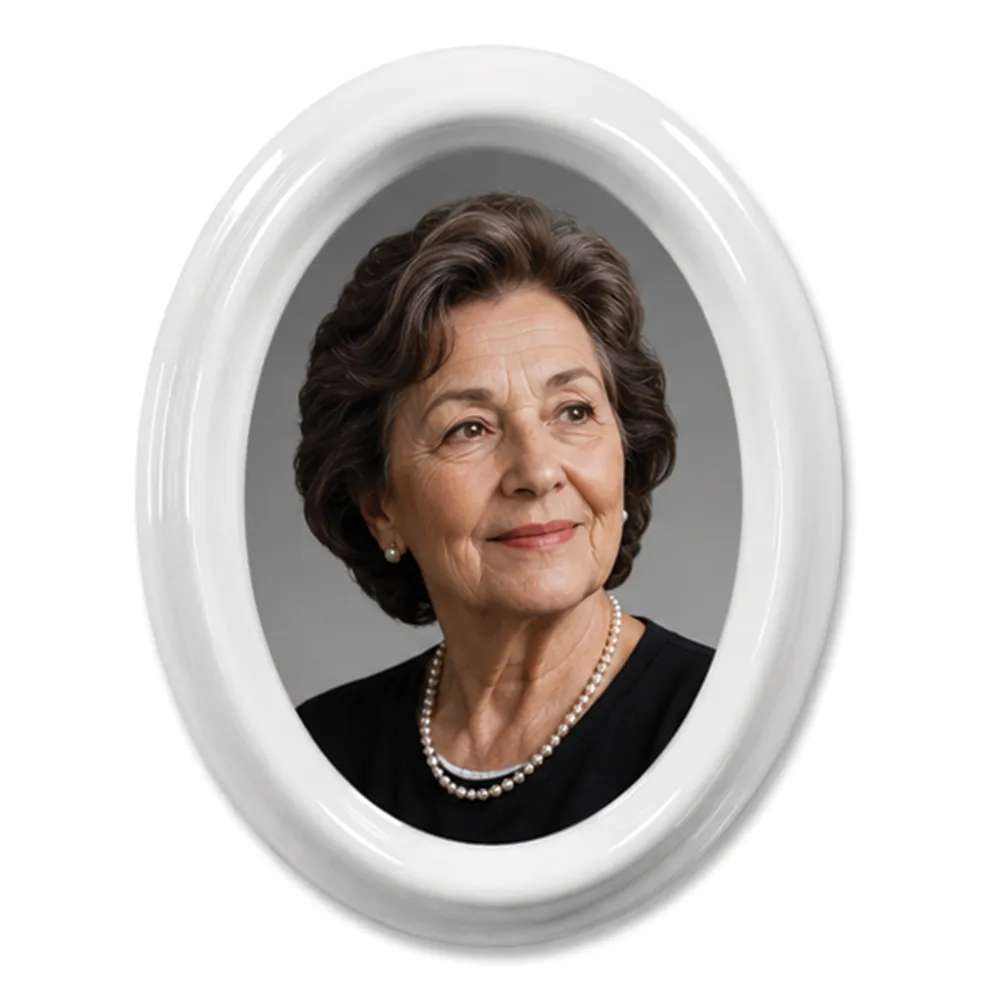
Bohemia ceramic photo for gravestone crosses

Bohemia ceramic photo with gold trim

Rectangular ceramic photo for gravestone crosses

Rectangular ceramic photo with gold trim

Papyrus ceramic photo for gravestone crosses

Dome ceramic photo for gravestone crosses

Open Book ceramic photo for monuments

Heart-shaped ceramic photo

Round ceramic photo for gravestone crosses

Square ceramic photo for gravestone crosses
We create ceramic memorial photos for cemetery crosses and monuments that preserve the faces of your loved ones with dignity and respect. Upload the photograph, and we apply it to a ceramic plaque by ceramic decal transfer, fired at over 800°C. Choose the shape — oval, heart, dome, rectangle, book or another — to match the monument. On request, we can also add text: name and dates.
Each plaque is made of quality ceramic, with the image fired at high temperature, which guarantees a clear photo that resists sun, rain, frost and the passage of time. The photograph keeps its detail for many years and is easy to mount on a cross or monument.
Ordering is simple: upload your photo, add text if you wish, and place your order. We deliver by international courier to the European countries listed in the order form, within 7-14 working days. Shipping is included in the price shown.
Ceramic photo for a grave cross — what it is and how long it lasts
A ceramic photo for a grave cross is a ceramic or porcelain plaque on which the photograph of your loved one is not printed on top, but fired into the surface at a high temperature. The difference seems small, but it decides everything: a laminated photo turns yellow after two or three years in the sun, while an image fused into ceramic stays clear for decades.
The layer fired at high temperature holds up well to ultraviolet light, rain and frost. It needs no maintenance — wiping it with a damp cloth a few times a year is enough. The only thing that can damage it is a knock: ceramic is hard but brittle, and a plaque forced into a recess that is too tight can crack.
In European cemeteries you can see plaques fitted several decades ago that still keep their detail. The practical limit is not the image, but the physical integrity of the plaque and of the fitting.
Memorial photo plaque prices — what affects the cost
Our prices start with the small round shape and the classic oval, and rise with the size and the shape you choose. The price depends on three things: the shape, the size and how much work the outline takes — an oval with a gold rim takes more work than a plain one.
What does not affect the price with us: the condition of the photograph. Restoring old, torn or yellowed photos, colourising black-and-white ones, retouching and cutting a person out of a group photo are included in the price shown. This is exactly where offers can differ widely: some workshops charge separately for restoration and colourisation, so the final price can rise considerably.
Delivery within the EU is included in the price shown on each product, so nothing is added at checkout. Delivery takes 7–14 working days. Payment is made online, by card, when you place your order.
Photos for a grave cross — shapes and sizes
We offer twelve shapes, in sizes from 8x8 cm up to 24x30 cm. The vertical oval is a traditional shape that suits almost any cross. The rectangle sits better on modern memorials with straight lines. The dome echoes the curve of crosses with an arched top, and the open book is the only shape with its own space for text.
The choice depends first on the stone: if the memorial has a cut recess, it dictates the size, and the plaque should go in with a millimetre or two of clearance, never forced. If the photo is bonded to a flat surface, you have complete freedom and the choice depends on the distance from which the memorial is seen.
A simple guide: at two or three steps, 12.5x9.5 cm is enough; from five or six steps, or on a tall memorial, 15x11 or 18x13 cm keeps the face recognisable. If you are torn between two sizes, choose the smaller one — a slightly more discreet photo looks good anyway, while one that is too large cannot be corrected after fitting.
Memorial photo — which materials it can be fitted to
A ceramic memorial photo can be fitted to any hard surface: marble, granite of any colour, mosaic, concrete, even wooden crosses. This is its main advantage over laser engraving, which requires black or very dark polished granite — on white marble there is no contrast and the portrait can barely be made out.
It is fitted with neutral-cure silicone or a two-component stone adhesive, on a clean, dry surface, at above five degrees Celsius. It takes less than half an hour and needs no special tools. Ordinary acetic silicone, the kind used in bathrooms, is not suitable: over the years it can leave a yellowish outline on marble.
If the plaque breaks or is lost, it can be remade at any time, even years later — you simply order another and fit it. A faulty or worn engraving cannot be corrected without resurfacing the stone.
Photos on grave crosses — why ceramic rather than engraving
A ceramic photo is a photographic image, with full tones and, if you wish, in colour. The face looks as it did in the photograph. Laser engraving is a drawing made of dots in the polished layer of the granite: the result is white on black, graphic, closer to a sketch than to a photograph.
Neither is better in absolute terms. Ceramic looks more like the person; engraving blends more with the stone. Engraving lasts as long as the stone, but loses contrast as the polished surface becomes matt. Ceramic keeps its contrast much better over time, but it is brittle.
In practice, if the memorial already exists and is not made of polished black granite, a ceramic photo is the only option that looks good. And in terms of cost, engraving is usually paid to the stonemason and ends up more expensive than a plaque of comparable size.
Photographs for a memorial — which photo works
Only one thing matters: the face must be distinguishable. Not the age of the photo, not the condition of the paper. Scratches, yellowing, torn corners, damp stains, a distracting background or other people in the frame — all of these are dealt with during editing, which is included in the price.
It is best to send the original file from your phone or computer, not a screenshot and not a photo forwarded through a messaging app, which has already been compressed. If you only have a paper photograph, lay it on a table in daylight, without flash, and photograph it holding the phone parallel to it, not at an angle.
Before firing, we send you a preview showing exactly what will go on the plaque. If the file will not hold up at the size ordered, we let you know and suggest an alternative — we would rather ask than deliver a blurred photo on stone.
Funeral photo ceramics — how they are made
Funeral photo ceramics is the process in which the photograph is not printed on top of a backing, but fired directly into the surface of ceramic or porcelain at a high temperature. The result holds up well to sun and moisture — unlike a laminated photograph, which loses its colours in two or three years.
The process has six steps: restoring the photograph we receive, colourising it if it is black-and-white and the family wishes, cutting it to the chosen shape, sending the preview for approval, the firing itself and packing for shipment. All the work before firing is included in the price, however damaged the original photograph is.
It can be fitted to any existing memorial — marble, granite of any colour, mosaic or concrete — unlike laser engraving, which requires polished black granite. This is why photo ceramics has remained, for over a century, the standard solution in European cemeteries.
Photo on ceramic — how it differs from prints and engraving
“Photo on ceramic” means exactly the photo ceramics described above: an image fired into the surface of the plaque, not printed or glued on top of it. The difference shows over time — an ordinary print, even laminated, turns yellow and peels after a few years in the weather; an image fired into ceramic stays stable for decades.
Unlike laser engraving on stone, which produces a black-and-white drawing made of dots, a photo on ceramic keeps the full tones of the photograph, including colour, if the original has it or if we add it through colourisation. The face stays recognisable as it was in the photo, not turned into an engraved sketch.
The shape and size are chosen according to the memorial: if the stone already has a cut recess, it dictates the size; if the surface is free, the choice is yours. We send you an exact preview before production, whatever the shape.
Frequently asked questions
What material is the plaque made of?
The plaque is made of quality ceramic (porcelain), and the photograph is applied by ceramic decal transfer, fired at over 800°C, for a durable result.
Does the photo withstand the weather?
Yes. The ceramic photo withstands sun, rain, frost and temperature changes, and keeps its image for many years outdoors, on a cross or monument.
How long does delivery take?
Production and delivery by international courier to the European countries listed in the order form take a total of 7-14 working days.
How much does shipping cost?
Shipping is included in the price shown on the site, so you pay nothing extra for delivery.
What should the photograph look like?
We recommend as clear a photo of the face as possible, with good resolution. You can also use an older photograph — if needed, we do discreet retouching, restoration and colorization before production, at no extra cost.
What shapes and sizes do you offer?
We offer several shapes — oval, heart, dome, rectangle, book and others — in standard sizes, suitable for mounting on a cross or monument. For a special size, please contact us.
Will the photo fade over time?
The image is made to last: we use ceramic decal transfer, fired at over 800°C, and the fired layer holds up well to sun and rain under normal outdoor exposure.
How can I pay?
You pay online by card, on the secure Stripe payment page. Cash on delivery is available only for delivery within Romania.